5 inspirational business quotes to start your business day!

We thought we’d do something a bit different for this blog post.

Trying to digest a couple of inspirational quotes each day helps with motivation, idea development and innovation. Even if they are not meant to be business related, they can easily have plenty of relevance!

“The reasonable man adapts himself to the world; the unreasonable one persists in trying to adapt the world to himself. Therefore all progress depends on the unreasonable man.” – George Bernard Shaw

“I failed my way to success.” – Thomas Edison

“You can’t solve a problem on the same level that it was created. You have to rise above it to the next level.”Albert Einstein

“Do not follow where the path may lead. Go instead where there is no path and leave a trail.” – Harold R. McAlindon

“Of course motivation is not permanent. But then, neither is bathing; but it is something you should do on a regular basis.” ― Zig Ziglar


Poor-sellers, stock clearances and opportunity cost

Bargain basement bins are great; everybody loves them. Most people have a dig through them to see if there is anything worthwhile, on offer. At face value, it looks like a good opportunity for a business; consumers come in for one item and they buy 2, maybe 3. At the same time, businesses get rid of their least valuable stock.

What’s the catch?

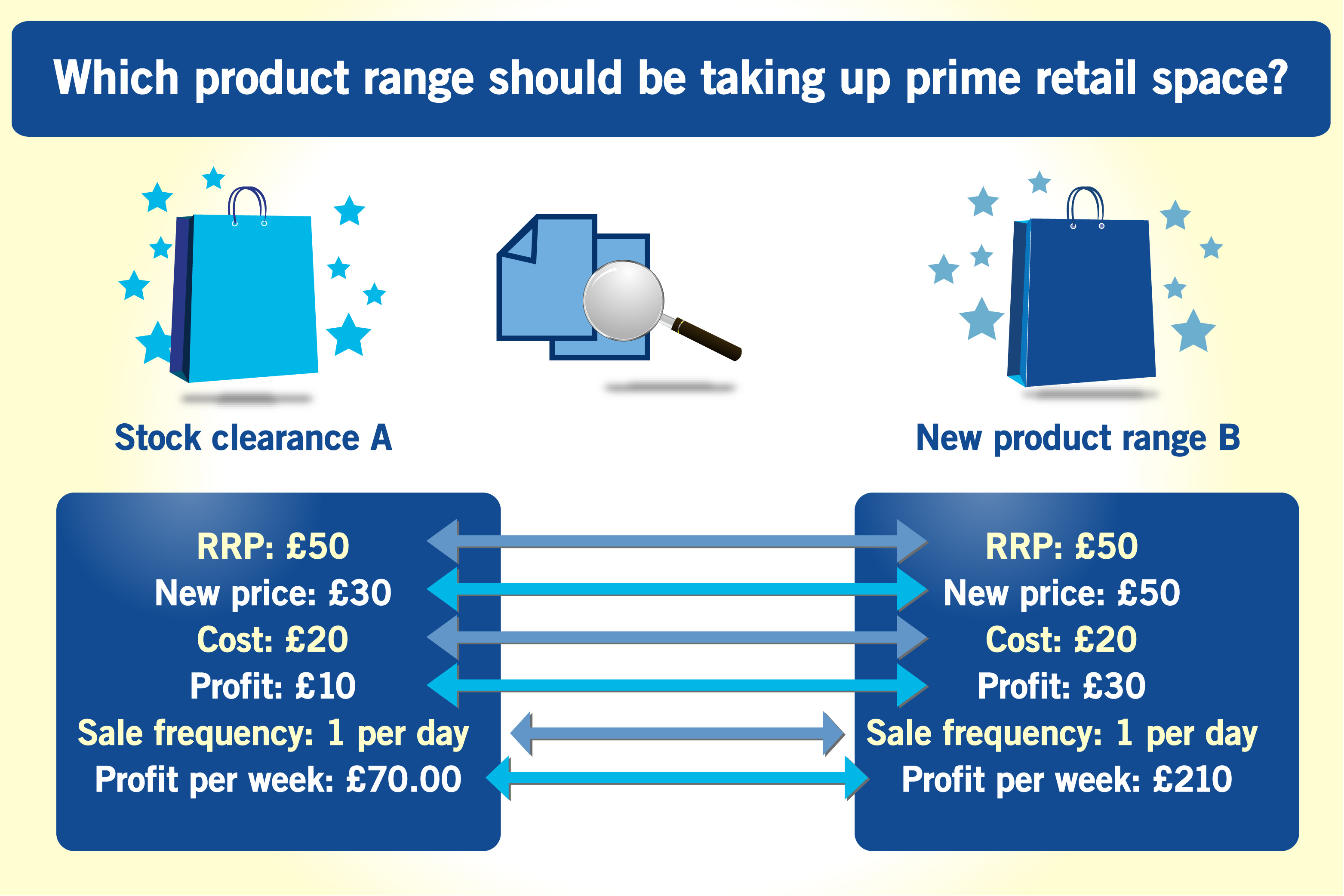
The fact is; it doesn’t actually make business sense. Many businesses are trying to release their cash held in stock, by stuffing their “shop floors” (or e-commerce sites), with items, that they know do not sell well. They have not calculated that there is a huge opportunity cost involved.

A quick example has been outlined below. The business has found that at full RRP, the product is not really selling, so they want to decrease their stock holding, considerably, or completely.

New product range A is obviously the one that the shop should focus on. The e-commerce store or retailer would be much better off concentrating on the display and promotion of this product range, rather than wasting valuable space on stock clearance A. This product range might only take up 20 sq ft of the shop floor, or two products on the home page of an e-commerce site, but that is prime space, which could be generating a much higher profit.

Things to consider

  • “Stock clearances” that act as a loss leader are worthwhile
  • Filling prime retail space with poor-sellers means that the sales volume of best-sellers is reduced
  • There are other options to rid a business of “dead” stock: selling on eBay, to other stores in bulk and even back to the original wholesaler/distributor.
  • Before putting poor-sellers in a prime position in a shop or on an e-commerce store, think about the effects it will have on current best sellers.


Blogs for Businesses; who reads them anyway?

Visit 99.9% of business blogs and what will unveil itself is a mass of poorly written, promotional posts. Businesses seem persistent when it comes to using their blog as one big advertisement.

STOP!

There is no need! Visitors have already got to the landing page of the business. The “advertising” stage of the business is DONE. Now it is time to engage, not PROMOTE.

77.7 million unique visitors in the US (Technorati)

77% of active US Internet users, read blogs (Technorati)

There are millions of websites, online. Most get traffic, most get sales. Most do not get as much as they should, of either. Why? If users do not engage or connect with a site, they do not feel comfortable!

Notice how this blog post, and all the others here, do not blatantly promote any services (we may offer them from time to time, if relevant to the post). The idea behind posts is to offer our readers value. It’s that simple, many may already know it, but if so, many are ignoring it. A blog is to engage and not promote.

Offering readers value might mean they just come back to a post for reference, visit once a week, but the aim is that eventually; they will be revenue generating consumers. Why would they order from anyone else, when they consistently visit a site which provides useful and relevant information?

Posts that don’t work

  • Generic explanations
  • Keyword junk

Savvy online users know these posts are “fudged” to try and manipulate search engine results. Most of these articles will never even be clicked on, as they offer no value!

Posts that do work

  • News relevant to your industry and its customers
  • ‘How To’ posts
  • An information piece relating to the business, like this one!

Generating ideas

When creating posts, always think about who will be at the other side of a computer screen. For example, as a media company, writing a post on how to pass school examinations would not be ideal; the target audience is too young and their cash flow is not suitable.

Writing a post about WordPress plug-ins gives us a readership of people that own websites and want to improve them. It is a distinct possibility that many are business owners with blogs, which we could manage; and they are struggling to get the most out of WordPress!

Think of the target audience, what they need to know; that is what needs to be posted.


Outsourcing over Employment; introducing the Pareto principle

Understood by many, yet only used by few; outsourcing makes sense.

Unlike the misconception most people have regarding outsourcing, it doesn’t always include off-shore companies, or low quality services.

Pareto principle, in summary, is an 80/20 rule, which can be applied to most things. The relationship is an imbalance between an input and an output, two factors, not always 80% and not always 20%. In fact, the relationship does not have add up to 100. 20% of employees could easily create 90% of profits. The principle simply shows an imbalance.

Examples of how the Pareto principle has a huge impact, daily

  • 80% revenue goes to 20% of businesses
  • 80% of leads come from 20% of the marketing budget
  • 80% of a result comes from just 20% of effort

Or…

  • 20% of staff create 80% of productivity
  • 20% of a day is productive, whilst 80% is wasted
  • 20% of marketing campaigns work, 80% don’t

The Pareto principle, in theory, relates to anything. Identifying where an imbalance is and how it can be altered has allowed many large corporations to profit. There is a realistic possibility that 20% of time or effort could produce 80% of an end result. What does this mean? A huge portion of time, energy, resources and money are being wasted.

How does this relate to outsourcing?

The employee

Junior Digital Marketer (Sam): £20,000 per annum

Main skills: Website Copywriting (years of experience, natural flair for great ads etc.)

Other skills: (adequate in terms of education, but practical experience and natural ability is lacking) Web design, copywriting, social media marketing, web analytics and email marketing

Hold the phones; don’t blame Sam!

Sam clearly has one core skill. The employer has probably recognised this, hence employing Sam, in the first place. Yet, they still prove the 80/20 rule correct, allowing Sam to spend 80% of their time on wasteful projects, when the real ROI, is with copywriting campaigns.

Why would anyone be so wasteful?

HR management is not exactly easy; finding good employees can be hard. Even when they are found, the work load is not always there. If an employee has free time, naturally their employer will move them onto another project; web design, or maybe PPC campaigns.

Consider Sam in a new perspective! Sam is productive 20% of the time (when he is copywriting), on a wage of £20,000. Essentially, £4,000 of their salary is well spent, with £16,000 being wasted.

Yes, it is understood that there are many variables not taken into account. Sam may be productive, to an extent, when producing PPC campaigns; but then holiday pay would probably offset that. Sam’s wage might be 20% less; but then again, lunch breaks and times of distraction have not been accounted for – the list goes on.

 

This is an abstract puzzle; put it together in a way that it can work, relative to how a business operates.


Pareto principle is not a “Holy Grail”. Each business owner needs to apply it to a mechanical component within their business; office wastage, distribution or HR. Are 80% of employees only producing 20% of the work? Are 80% of products only creating 20% of the revenue?

#1 Cost efficiency and quality assurance

Getting a fixed price on a project will mean better value. Outsourced work is billed to clients, based on productivity that is the 20% mentioned above. On that basis, the copywriting project could have been outsourced, for just £4,000, and will be much better quality.


Why? An employee is paid; regardless. Outsourcers are paid based on their overall output, which includes quality.

#2 Efficient allocation of resources

The copywriter will get results; when copywriting. Any time they spend on other marketing projects is wasteful. Example: A PPC professional may be able to get 2.5% conversion on a £10,000 campaign, where the copywriting specialist is is likely to get much lower; say 1%.

#3 Increased capacity

Being able to increase capacity (the ability to produce more, sell more and ultimately; create a higher revenue), with the same resources, is priceless. Many businesses have been victims of their own success, suffering from over expansion. They move from a home based £50,000 p/a operation, to an office based £250,000 p/a within 2 years. That can’t be bad!? It can, and here is why…

Most businesses have a maximum capacity. They can deal with 100 orders a day, service 10 clients per month or produce 1,000 items a week. For X revenue, Y expenditure will usually take place first.

If they are producing 5X, then they need 5Y. Dependant on the business, this could mean: bigger bank loans, expensive machinery, higher rent and extra salaries. Add up the sums and it equals risk. They are committing! When times get tough, cash flow is the first one to take a battering and many companies go under. Outsourcing allows a company to expand, with the same resources they have always been committed to.

Summary

Back to the original point; understood by many, yet only used by few; outsourcing makes sense.

Outsourcing key business related tasks allows a business to ensure they achieve:

  • Great value for money
  • High quality output
  • Efficient allocation of resources
  • Increased capacity