How to Use Hashtags for Online Marketing

Now that Facebook has introduced hashtags, they are of even more use to digital marketers looking to get their site found before a competitor’s. However, that’s assuming that everyone gets it right, which of course they don’t.

Hashtags are really just another way of searching for content that interests you. Savvy marketers know this and use various techniques to ensure that their content is as visible as possible.

How To Use Hashtags -2

Photo Credit: halfbrown

Unfortunately, hashtags have also quickly become one of the most irritating things on the net, thanks to hashtag stuffers and general abusers. You know the type, those that are incapable of using a sentence without #hashtags #on #every #single #word. Whilst this is often an attempt at being funny or ironic, sometimes it’s used as people actually do think this will ‘amplify an audience’.

It won’t of course, it just irritates the user that is sent here, there and everywhere during a search and it’s likely they will pay no attention to the content at all.

Cardinal rules of hashtag usage

  1. Use sparingly
  2. Use intelligently
  3. Don’t use other people’s
  4. Don’t overuse so that it looks like a whole sentence in one tag (suchaslikethisasnoonewillunderstanditjustbecauseofhowthebrainworks)
  5. Do use keywords
  6. Ensure that it’s relevant to the post content
  7. Keep phrases short and snappy
  8. Use lower and upper case letters

Hashtags for brands

The use of a primary hashtag on all brand related stationary, media and packaging can really help to strengthen a brand. It’s an ideal way of ensuring that you have a snappy little phrase or word, which customers can immediately associate with the brand.

This can also be placed on website landing pages and used in Instagram or Vine, to ensure that images and video by the brand are easily discoverable. It’s worth carrying out some keyword research here, so that your brand can really compete.

How To Use Hashtags -1

(image source: http://www.dailymail.co.uk/sciencetech/article-2359525/Revealed-The-seven-types-Twitter-hashtag-abuser-So-you.html)

Secondary hashtags and use on social

Once you have settled on your brand’s hashtag, you can begin to experiment with secondary tags, such as product and event tags. These are especially useful for promoting upcoming events or new product release, amongst other things.

As you can see by the above example, this can be clickable content on social that take the user to the page where you want to direct them. Try to stick to one or two key phrases and ensure that they are immediately legible when viewed.

To do this, it’s sometimes necessary to mix up lower and upper case letters, for example, #hashtagshituk can be interpreted very differently to #HashtagsHitUK!

It’s also wise to ensure that hashtags are well aligned with your industry and brand, so if you have a site that sells shoes, you could have #shinyshoes #UniqueShoes and so on.

Join the conversation

You may have come across this phrase before in advertising material when a company is promoting a Q&A session, or simply attempting to reach its audience by hosting a Twitter chat.

Here you can use your primary tag along with a tag for the conversation. So, if you’re hosting a chat about whether kids should use social media and you’re a kid’s clothes reseller, you could have your primary tag of #KiddyClothing and a conversation tag of #KidsOnFacebook.

Then it’s just a case of starting the conversation and waiting for replies, which should be answered more or less immediately if you want the campaign to have any success. Modern internet marketing depends on you connecting with and engaging your followers and this is a great way to achieve this.

Always bear in mind that the internet is now a social place and as such, you should speak with a personal tone, not a corporate one. Choose a member of staff that can think on their feet, are friendly and diplomatic and you can’t go too far wrong.

Piggybacking is for the unimaginative

How To Use Hashtags -3

Some people will tell you that a brand with a successful hashtag that’s gone viral is a great chance for you to ride on the back of this success. This isn’t a good idea; in fact the best ideas are those that you think up for yourself.

Think about it. A user is searching for the hashtag of a particular brand, as they know that it means some good offers are available; instead they find yours, which is unrelated to the brand they are searching for. Would you be happy? This is more likely to lose you fans and gain you a reputation for cheating, more than any positive effect it may have.

Dealing with hijacks and other problems

Hashtag hijacking does exist (the above is an example of that), so you should monitor channels where you use them to ensure that you have control. This has happened to even the biggest of brands, such as McDonalds, and it’s vital that if happens to you that you address it.

This should be done in a similar way to social media complaints:

  • Be transparent, tell your audience what’s happening
  • Be good natured and friendly in your dealings with people
  • Apologise to any followers it may have offended and explain the situation
  • Use it as a PR exercise

Internet trolls love to make trouble, so it’s important that you don’t take it personally or let it annoy you. Followers may very well surprise you with their support if you handle the situation correctly.

Tracking, analysis and tools

Firstly, use Google Trends in order to carry out some research for your industry and locality. There are plenty of software options for tracking hashtags that you use, so that you can measure their performance, Hashtracking is one that gives reasonably in-depth insights, whilst Tweetreach is a very popular tools used by many marketers.

You may have to experiment in the first instance when researching hashtags, but you will soon get the hang of it, especially if you already carry out keyword research for your site and content.

Hashtags are extremely useful as part of your social marketing, so learn to use them properly, track them effectively and don’t be tempted to use for irony, although a little humour can be a good thing.

 

How To Remove A Google Manual Penalty

As all webmasters will surely know by now, the Penguin and Panda algorithm updates from Google have caused some chaos for many sites this year. Not only have many sites found themselves dropping down the SERPs like a stone, Interflora flower suppliers got hit with a penalty following the discovery of paid advertorial links in February.

More recently, both the BBC and Mozilla have received manual penalty notices, due to what was thought to be unnatural linking on both sites. This has thrown up the question in many forums exactly how Google is imposing these penalties, especially since the aforementioned penalties only targeted specific pages.

At the end of May, Google’s Matt Cutts released a video surrounding advertorials, paid links and full disclosure. In it, he states that any link that appears have been placed in content that has been paid for must have rel=”nofollow” and it should be clear to site visitors that it is promotional.

How to remove a Google manual penalty - 2

He also said that people who receive manual penalties and submit a reconsideration request would get a “clear answer” about where they’re going wrong.

Know your link profile

Many webmasters and designers use the footer of a site to place a link to their own site as the creators in order to gain more business. According to Google: “Widely distributed links in the footers of various sites” may “negatively impact a site’s ranking in search results”. The guidelines also cite this as a “common example (sic) of unnatural links that violate [their] guidelines”.

In a recent interview, Matt Cutts advised anyone that has received a webspam penalty to hit the forums for advice, but is this enough?

In the first instance, taking a good look at your link profile is advisable and this can be carried out using Lynx web browser, as it allows a site to be viewed in the same way that a search robot would look at it. You can also use Open Site Explorer to look at links specifically.

Look at:

  • Anchor text variants
  • Link quality
  • Where the links are coming from
  • Site wide links

Then once you think you’ve found the culprits, if you’re not managing it, ask the webmaster to add rel=”nofollow” to the <a> tag or use a robots.txt file to block from search engines.

As simple as this sounds on the face of it, it’s not always possible to get a response from site owners, especially if the sites are no longer really used and this is where the problems occur.

Overcoming the penalty

The first step is to get together a spreadsheet of all of the links on a spreadsheet. This should include all of the links you’ve managed to have altered and should contain:

  • Link status (altered or live)
  • Links to and from URL
  • Anchor text
  • Email address for linked from site
  • Removal request dates

It’s also advisable to set up a dedicated Gmail address to deal specifically with this problem and nothing else. This allows you to keep a full record of any communications for further proof that you’ve addressed the problem.

You can also find plenty of link removal tools online to help if you have a large link profile.

Tell Google all about it

Once you’re sure that you’ve done as much as possible to clean up the link profile, then it’s time to appeal to Google for resubmission. This should be a detailed explanation of what’s gone wrong, how you’ve dealt with the problem and so on.

However, at this point it’s worth pointing out that first-time requests tend to be unsuccessful, so don’t lose heart if this is the case.

Disavow tool

It’s only recommended that you use the disavow tool as a last resort if you’re having serious problems getting backlinks removed. Before doing so though, have a good look at the overall SEO for the site.

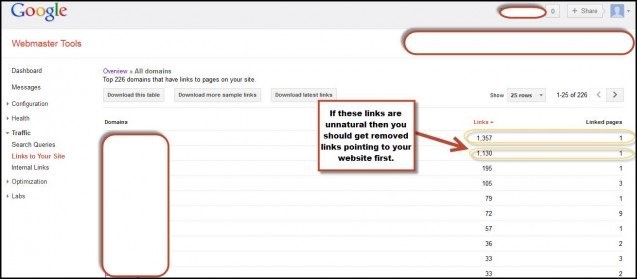
You can download links from within Webmaster tools and going to the dashboard, clicking ‘Search Traffic’ and ‘Links to your site’. Then choose ‘who links the most’ and download the URL list.

How to remove a Google manual penalty - 1

According to Google: “This is an advanced feature and should only be used with caution. If used incorrectly, this feature can potentially harm your site’s performance in Google’s search results.”

They also recommend that the tool be used only if all other steps have been taken. In general, Google will actually respond to the request and if they can see you have made an effort to address it, even if they don’t immediately lift the penalty, they can help you see what else needs to be done.

If the disavow tool is the only option

If you feel you have no choice when it comes to using the disavow tool, then use the information you downloaded to create a text file, which must be .txt and UTF-8 or 7-but ASCII encoded. Allow one link per line and ensure that you only add links that you want Google to ignore.

A valid file should look something like the below:

# example.com removed most links, but missed these
http://spam.example.com/stuff/comments.html
http://spam.example.com/stuff/paid-links.html
# Contacted owner of shadyseo.com on 7/1/2012 to
# ask for link removal but got no response
domain:shadyseo.com

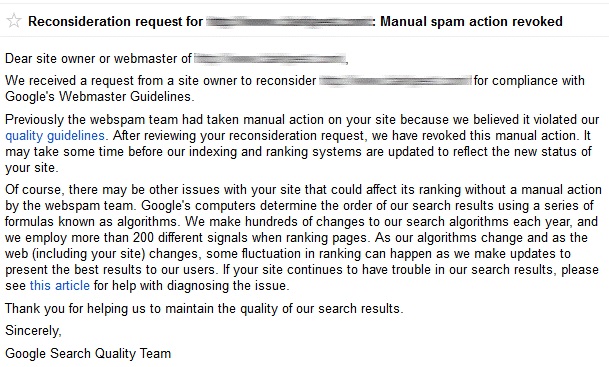
Then it’s just a case of uploading the file and selecting your site and clicking the Disavow links button. Hopefully you should then receive a communication from Google such as the one below:

How to remove a Google manual penalty - 3


5 Places To Get Links Before Employing An SEO Company

Although an SEO company can do wonders for your online presence, there are some links that even they can’t get.

The main thing to consider is that there are plenty of webmasters that you already have a relationship with; you have probably just not realised it yet.

Here are some ideas to obtain a couple of links that your competitors won’t have…

SEO-OUTSOURCING-COMPANY-LINK

1. Content Writing Providers, Web Designers & Coders
Did you use a content writing service provider when you started your website? Has your website been professionally designed? Did a coder produce a bespoke CMS?

Most content writers, designers and coders will have a portfolio. Check out there portfolio and see if they are linking to their clients. If they are, ask them if your company can be featured.

2. Uniform Suppliers & Sign Writers

Have you recently purchased new uniforms or had a van sign written?

Most websites will have a page that you could get a link on such as:

  • Related links
  • Partners
  • Resources

It is unlikely that your supplier/service provider is going to say no; you have lined their pockets after all!

3. Friends & family

Do your friends and family have a website? Maybe they run a blog or have recently started an online store? Get a link on their site and give them 1-2 hours help in return.

An SEO company will work on a building relationship in an effort to get links; you already have that relationship!

4. Training Providers

Education and training is something that is never finished; it is always work-in-progress.

If you are using or have used training providers, see if they can offer you a link. Maybe they could produce a success story/case study based on you completing the course? 

5. Business clubs

Business breakfast meetings have become extremely popular throughout the world. After going to these meetings just 2-3 times, you will have already made some great contacts.

Not Doing E-commerce SEO? Here Is What You Could Be Missing Out On!

Let’s break down a niche quickly and see what it could mean in terms of sales and profit for your company…

We actually have experience running a store and doing ongoing e-commerce SEO; it really pays dividends.

Here is an example of an incredibly small niche in the extreme sports industry; motocross.

Based on local (UK searches) and exact match keywords (the exact phrase, not a variation), here are some figures (as of 03/06/2013):

Keyword Monthly exact local   searches
Motocross helmets 1,000
Motocross gear 1,300
Motocross boots 590


Using e-commerce search engine optimisation for just 3 key phrases, there is the potential for just under 2,000 visitors per month.

  • Based on research here, you can expect a click through rate (CTR) of 42.13% for being 1st position for a keyword.
  • With 1,890 searches, your site would receive 796 visitors per month in 1st position.
  • The average order basket for online shoppers in the UK is around £81.00, with these stores getting conversion rates of 4.35%. (New Media Trend Watch).
  • This would mean that by ranking for just 3 search terms mentioned above, that would create 415 sales a year and £33,656 in turnover.

Now we know that this niche has hundreds of smaller search terms getting 200-500 searches per month that can be ranked for. By ranking for the initial 3 search terms (all covering “motocross”), the site will become stronger in the niche on the whole. Ranking for the other phrases therefore would not difficult.

With a solid search engine optimisation campaign in place, it would be reasonable to say that within a year of implementing e-commerce SEO, the site could be ranking in the top 10 for 100+ of the most popular related phrases.

Of course, all of these figures do not include customers that return in the future.

Now consider some other products and niches, maybe you even sell some of these products but are not ranking for the key phrase.

How much annual revenue could this produce for your company based on the stats mentioned above?


Keyword Monthly exact local   searches Potential revenue
Walking shoes 5,400 £96,192
Winter coats 9,900 £176,352
Office furniture 27,100 £482,743